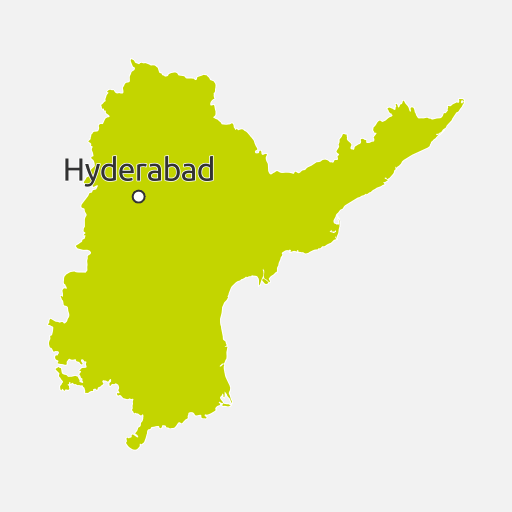
Andhra Pradesh, located on the south east coast of the Indian peninsula, is the 8th largest state by area. In 2014, the northwestern part of the state was carved out to form a new state, Telangana. The power generating assets were divided up, with 46% in Andhra Pradesh and 54% in Telangana. At the end of 2015, the new, smaller state of Andhra Pradesh had installed renewable energy capacity of 1,883MW, which was just over 11% of the total 17,049MW.
Owing to uncertainty post bifurcation, growth in renewables slowed in 2015 compared with 2014, although activity has picked up in 2016. In the first seven months of 2016, over 20 times more solar was installed than in 2015. The state’s grid-connected solar PV capacity totalled 936MW by the end of July 2016.
It was a similar story in wind. In the first seven months of 2016, the state added 1.5 times the capacity installed in 2015. The state total at the end of July 2016 was 1,560MW.
Andhra Pradesh adopted solar and wind power policies in 2015. These set a cumulative capacity target of 5GW of grid-connected solar and 4GW of wind power capacity by 2020. Looking further ahead, the state’s share in the 175GW renewable energy target announced by the federal government for 2022 is 9,834MW of solar, 8,100MW of wind and 543MW of biomass power. Its solar policy also set a target to establish 2.5GW of capacity through state government-sponsored solar parks.
The state provides various incentives to developers of renewables in the form of exemption from transmission and distribution charges for wheeling (transmitting) of power for sale to a third party user within the state, and exemption from distribution losses incurred when injecting solar power at 33kV or below into the grid. It also facilitates 100% ‘banking’ of renewable power (whereby the producers can virtually ‘bank’ or store power in the grid) and exempts producers from electricity duty and cross-subsidy charges. Renewable power projects in the state also enjoy ‘must-run’ status as per the state policy and therefore will not face any curtailment.
State electricity distribution companies have a target to procure 2GW of solar power by 2020, as mandated by the state solar policy. One of the state’s two distribution utilities was assigned a ‘B+’ rating by the Ministry of Power, indicating moderate operational and financial performance capability, while the other was rated ‘B’, indicating below-average operational and financial performance.
In June 2016, Andhra Pradesh signed the federal government’s distribution utility debt restructuring scheme, the Ujwal Discom Assurance Yojna, or UDAY agreement. This will see the state take on distribution company debt of INR 110bn ($1.71bn) in the year ending March 2017, which is expected to reduce the interest burden of the two distribution companies by INR 3.3bn ($51.4m) this year. This measure is expected to provide short-term financial relief to the distribution companies. In the longer term, however, any turnaround will depend on their ability to reduce distribution losses and improve bill collection efficiencies.
In March 2016, it was announced that a tender for 400MW of capacity under the National Solar Mission had awarded tariffs of INR 4.43 per kWh ($6.65 cents per kWh) under the Viability Gap Funding scheme.
According to the federal government’s definition of rural electrification – which considers a village to be electrified if 10% of households have power – the state has already achieved 100% rural electrification, although there were 209,000 un-electrified rural households in June 2016.
Score summary
Andhra Pradesh scored 0.937 in Climatescope 2016, placing it 1st on the list of six Indian states surveyed in the current year. It ranked top on all parameters, except Greenhouse Gas Management Activities Parameter IV, in which it was placed last.
On Enabling Framework Parameter I, Andhra Pradesh scored 1.021. This reflects certain aspects of its power sector structure, including unbundled utilities and wholesale power market.
The state ran up a score of 0.301 on Clean Energy Investment and Climate Financing Parameter II, which was considerably higher than the others’ scores thanks to investment of $56m in 2015, and accumulated commitments of $236m since 2011.
On Low-Carbon Business & Clean Energy Value Chains Parameter III, Andhra Pradesh again led the field. Its score of 2.007 was helped by the presence of 21 clean energy value chains.
The state’s 0.917 score on Parameter IV placed it last among the six Indian states. It has not adopted any carbon policies and there are no carbon awareness initiatives.